

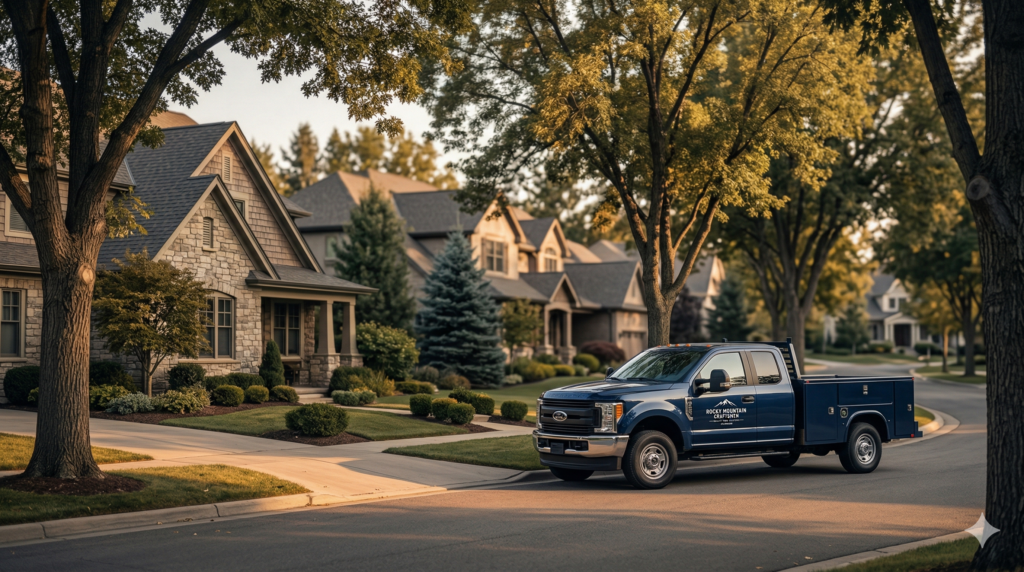
Most Colorado contractors are chasing reach. The ones quietly winning are doing the opposite. Going narrower, going deeper, becoming the only name that matters in the right zip code.
There is a difference between being everywhere and being the one. Generic brands are everywhere. Nobody is loyal to them. The store-brand version of almost anything sits right next to the name brand, costs less, and still loses. Not because the product is worse. Because it never built the feeling that makes someone reach for it without thinking.
That is the choice most contractors are making, usually without realizing it. Spread the budget across the metro. Run ads wherever the algorithm says to go. Show up in front of as many people as possible and hope that volume eventually converts. It feels like the right play. More reach, more opportunity.
It isn’t.
The Metro-Wide Trap
I talk to contractors every week across the south metro. The ones who are frustrated have something in common. They are not losing because their work is bad. They are often losing to contractors who do worse work. What those other contractors have isn’t skill. It’s familiarity. They are the name homeowners already have in their heads before they start searching.
By the time a homeowner is calling three companies and collecting bids, the decision has already started forming. Not consciously, not deliberately, but the names they recognize feel safer than the ones they don’t. A 10-year study by WPP and Oxford tracked 1.2 million customer journeys and found that 84 percent of purchase decisions are influenced by prior brand familiarity, before the active search even begins. The search is often just validation of a feeling that formed earlier.
The contractor who gets called first usually wins months before the search ever starts. That’s the part of the market most marketing completely ignores.
Metro-wide visibility means you are spending money to be a stranger in a hundred neighborhoods rather than a known name in one. The signal gets diluted. The homeowner who might have recognized you, if she had seen your name consistently in the same community over twelve consecutive months, instead sees you once in a sea of options and forgets you by Tuesday.
| Metro-Wide Strategy | Neighborhood Authority Strategy |
|---|---|
| Visible everywhere. Known nowhere. | One neighborhood. One name. First call. |
| Competing on price the moment they call. | Familiarity built before the need. Trust already in place when the phone rings. |
What Coke Actually Did
Coke didn’t beat Pepsi by having more distribution. For most of their history, both products were available everywhere. Coke won because it owned the mental shelf. That pre-loaded feeling people carry before they reach for anything. When someone thinks “soda,” Coke surfaces. Not because it ran more ads last Tuesday. Because decades of consistent, concentrated presence built a reflex.
That same dynamic plays out at the neighborhood level for local service businesses. The contractor who becomes familiar, whose name appears in the community magazine every month, whose articles homeowners read while the pasta boils, whose face shows up in the geo-targeted ad when those same homeowners are browsing later, doesn’t have to compete when the call comes in. They just have to answer it.
The Math Nobody Runs
When contractors hear “focused on one neighborhood,” the first reaction is usually the same. That feels small. It isn’t.
The mistake is measuring opportunity by geography instead of by job value and close rate.
A single roofing installation in an affluent home can run $35,000 to $60,000. At $1,000 a month in focused neighborhood presence, you need one job a year to cover the investment. Everything after that is margin, and the familiarity keeps compounding.
Here is what changes when a homeowner already knows your name before they call: the conversation starts from trust instead of skepticism. You are not one of three estimates. You are the person they already had in mind. Close rates on pre-trusted inquiries run dramatically higher than cold competitive bids. The difference between winning four out of ten and winning eight out of ten is not the pitch. It’s when the trust formed.
Two additional jobs at $30,000 each is $60,000 in incremental revenue from a $12,000 annual investment. Compounded over three years, as familiarity builds and referrals start to self-generate, the economics look nothing like what “marketing spend” normally produces.
Renting Attention vs. Building Equity
Every dollar spent on metro-wide reach disappears the moment you stop paying. Concentrated, consistent presence in a specific community compounds. The homeowner who sees your name twelve times in a trusted neighborhood publication, attached to useful articles, associated with families and stories she already cares about, develops a feeling about your business that no single Google ad can create. That feeling is built from accumulated familiarity, not a single transaction.
Businesses that try to win metro-wide before they’ve owned anything are building on sand. Businesses that plant a flag in one high-value community, stay consistent, and let the trust compound are building on bedrock. From that foundation, expanding to the next neighborhood is a much shorter conversation than starting from nothing across a market where nobody knows your name.
You don’t need the whole metro to trust you.
You need one neighborhood to know you first.
Start there. Think like Coke.
Toby Hanson is the founder of Trusted Contractors Colorado. He works with established home service businesses in the south Denver metro to build neighborhood authority. He writes on local marketing, trust timing, and community-first growth strategy.