

Walk into almost any local restaurant, gym, or salon and you’ll hear a version of the same frustration: “We can’t compete with the chains. They’re everywhere.”
It sounds like a budget problem. It isn’t.
Chains don’t win because they’re better. They win because they’re already familiar when the decision gets made. And by the time a new resident is looking for a place to become a regular, that decision is closer to finished than most local business owners realize.
The Game Is Habit, Not Discovery
Most local businesses think customers find them when they need them. Search for a coffee shop, pick one, maybe come back. That’s not how it works.
Oxford University and WPP Media’s research across 1.2 million consumer purchase journeys found that 84% of purchase decisions are driven by pre-existing brand bias. That’s true for roofing companies and financial advisors, but it’s even more consequential for restaurants, gyms, salons, and studios. Because here, the prize isn’t a single transaction. It’s a habit. A loyal gym member doesn’t reconsider their membership every month. A family that loves a neighborhood restaurant doesn’t comparison shop before Saturday dinner. They just go. The business that earns the first real visit, under the right conditions, often earns the next hundred.
The question is never “how do we get discovered.” The question is “how do we feel familiar before they ever walk in.”
The Window Most Businesses Miss Entirely
Every neighborhood has a moment that most local businesses ignore completely. Someone new moves in.
When a family relocates to a community, they aren’t slowly building their routines over years. They’re forming all of them at once. The gym, the coffee shop, the kids’ activities, the date night restaurant, the salon, the yoga studio — those slots are all open simultaneously, and they fill up fast. Within a few months, the routines are set. The habits are locked. And the businesses that felt familiar during that window are the ones that win the long game.
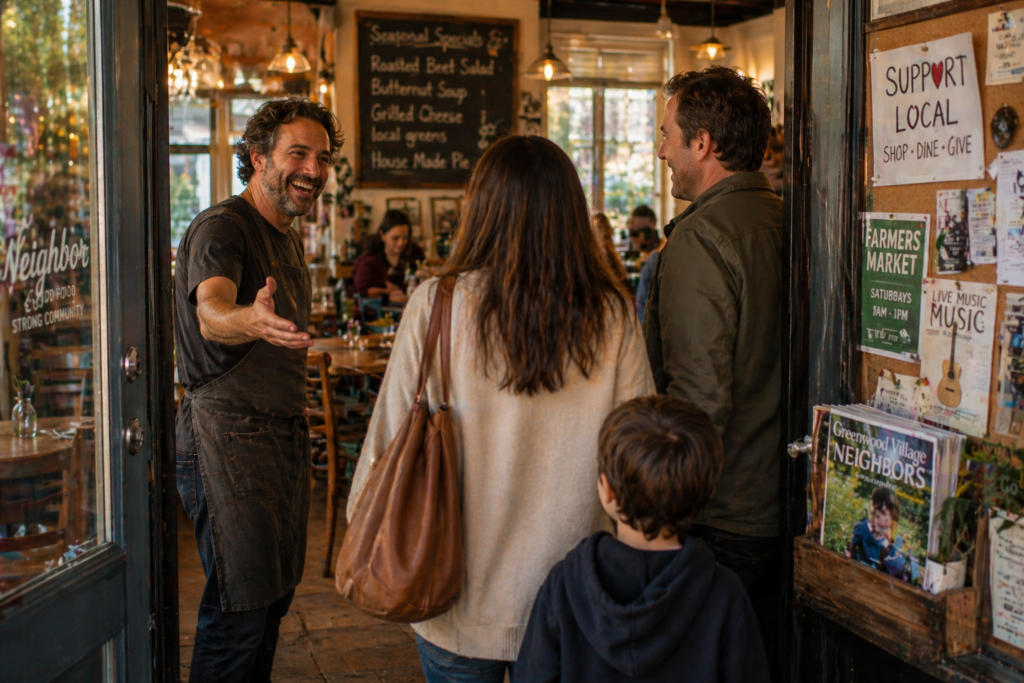
Familiar doesn’t mean they saw an ad. It means they heard the name from a neighbor. It means they recognized the brand from the community magazine sitting on the counter. It means they already had a sense of who you were before they needed to decide.
The businesses that capitalize on this aren’t running better promotions. They’re building presence before the need exists.
Why Chains Feel Impossible to Beat
A national fitness brand or a regional restaurant group understands something most independent owners don’t spend much time thinking about. They’re not trying to win the visit. They’re trying to win the moment before it. They invest in visibility inside trusted community environments, in consistent messaging over time, in being the name that surfaces naturally when a neighbor gives a recommendation.
So when a new resident asks around, or simply notices what everyone seems to know, the chain already has an answer on the table.
Here’s the thing: that strategy doesn’t require a national budget. It requires showing up consistently in the right place, for the right people, before they’re ready to decide.
The Advantage Independent Businesses Keep Ignoring
A chain can open a location in your neighborhood. It cannot become your neighborhood. That ground belongs to whoever claims it, and an independent restaurant or studio with genuine community roots should be winning this fight every time.
The residents who matter most in affluent neighborhoods aren’t looking for the cheapest option. They’re looking for the place that feels like theirs. They want to walk in and feel recognized, to recommend it without hesitation, to bring out-of-town guests there because it says something about where they live. Once they find that place, they don’t leave. And they tell everyone.
That’s not a customer. That’s a permanent asset to your business.
Awareness Is Not Enough
Most local businesses chase awareness. “I’ve seen that place.” That’s a start, but it’s not the finish line.
What you actually want is the kind of standing where residents say “that’s just where everyone goes.” The coffee shop that gets called out by name when a new neighbor asks for recommendations. The studio that parents mention without being asked. The restaurant that comes up at the first neighborhood gathering someone attends.
That kind of standing doesn’t come from a well-timed promotion. It comes from being present in the community long enough, and consistently enough, that you feel like part of it. Awareness gets you considered. Belonging gets you chosen.
Why Hyper-Local Wins
Trying to reach an entire city is expensive and thin. Becoming the known name inside a defined neighborhood is where momentum builds.
When you’re seen repeatedly by the same residents, in the same trusted context, something shifts. You stop feeling like a business they might try and start feeling like a place they already know. Referrals become automatic. New residents get pointed your direction in their first week. The neighborhood starts doing your marketing for you.
Chains win by being everywhere. Independent local businesses win by being inescapable somewhere.
The Bottom Line
You don’t beat national brands by outspending them. You beat them by out-positioning them, by becoming familiar to the residents who matter before they settle into their routines.
The goal isn’t to be found when someone searches. It’s to already feel like the obvious choice when a neighbor says “you have to check this place out.”
That’s not luck. That’s what happens when you start building before the habit forms.
If you’re a local business owner in the south Denver area and want to understand where you stand in your neighborhood, I offer a complimentary Local Positioning Session — a focused 20-minute conversation about your current presence and what’s possible.