

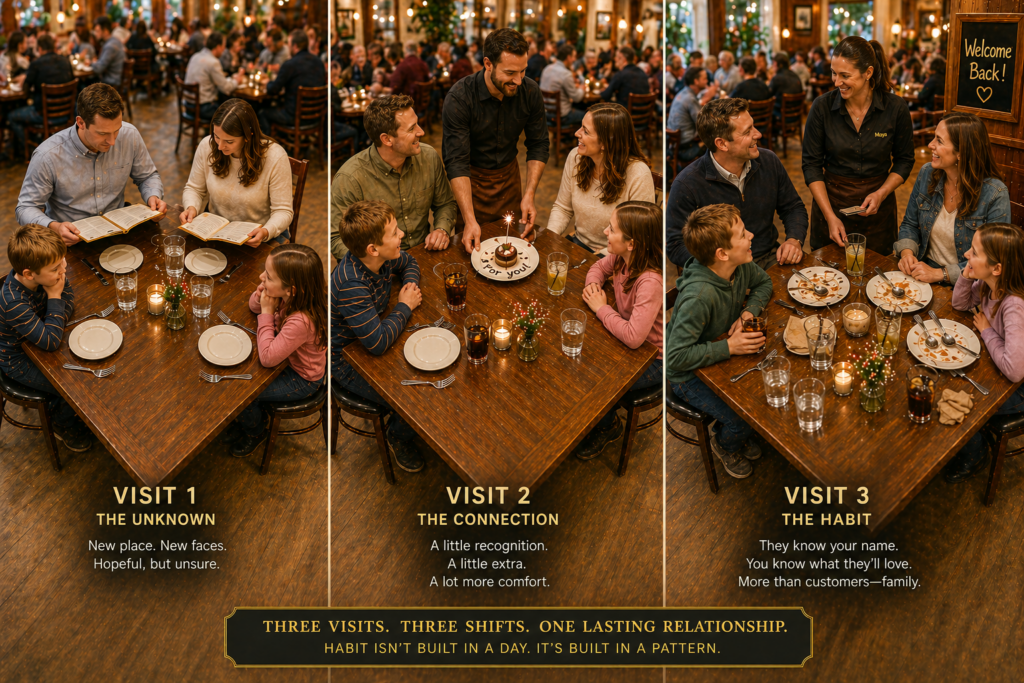
Most restaurants market for a first visit. The good ones should be marketing for the third.
There is a number that almost nobody in the restaurant business talks about, and it explains why so many places with excellent food and beautiful rooms still struggle to fill seats on a Tuesday. The number is 40%.
That is the statistical likelihood that a first-time guest who has a flawless experience will come back a second time. Not 70. Not 60. Forty percent. Which means more than half the people who love your restaurant will never walk through your door again. Not because the food was bad. Not because the server forgot something. Because your restaurant is not part of their life pattern yet.
The second visit barely moves the needle. A guest who has two perfect experiences still only has about a 42% chance of returning a third time. But here is where the math changes everything. After that third visit, the probability of a fourth jumps to over 70%. Three visits is where habit begins. Three visits is where a guest becomes a regular. And a regular is where the real economics of a restaurant live.
Jon Taffer has been saying this for years, and he is right. The industry is obsessed with the grand opening, the soft launch, the influencer dinner. All of it designed to generate a first impression. But a first impression, no matter how spectacular, only has a coin-flip chance of producing a second one.
The Real Math
Think about this from the other side. You have tried dozens of restaurants along the Front Range that you thought were fantastic. How many of them did you never go back to? Not because anything went wrong. Because life happened. Because it was twenty minutes out of your way. Because you forgot.
That forgetting is the entire problem.
The restaurants that thrive in this market are the ones that figured out something the rest have not. They do not try to create a once-in-a-lifetime experience. They try to create a pattern. A reason to come back Tuesday. And then again the following week.
The customer lifetime value math makes this obvious once you see it. A family of three that comes in twice a month with a $60 ticket is worth roughly $3,000 in profit over the five to seven years they remain a loyal customer. That is not revenue. That is profit. A single regular, acquired and retained, is a $3,000 asset walking through your door every other week.
So the question is not whether you can afford to give something away to earn that third visit. The question is whether you can afford not to.
Why Free Beats Discounts
There is a difference between giving a guest something for free and giving them a discount. Taffer draws a sharp line here, and the distinction matters more than most operators realize.
Discounts create expectation. A guest who gets 20% off once will look for 20% off again. You have trained them to wait for the deal. But a guest who receives a free appetizer on their second visit does not walk in expecting a free appetizer on the third. The gift registers as generosity, not as the baseline. You gave them something once. They do not assume you owe them something forever.
This is the lever that smart operators use to close the gap between visit one and visit three. The first visit gets them in the door. The second visit comes attached to something free, offered in person by the server while the guest is still at the table and feeling good about the experience. The third visit happens because you now have permission to reach them directly, through a loyalty program or a simple text, with a reason to come back.
Three touches. Three visits. A regular for life.
The Restaurants That Get This
The ones winning in south Denver right now are not the ones with the best Instagram presence or the most elaborate tasting menus. They are the ones that understand the difference between attention and habit. Attention gets a first visit. Habit gets the next two hundred.
If you run a restaurant in this market, stop measuring success by how many new faces walk in this month. Start measuring how many faces came back for the third time. That is the number that determines whether your restaurant is building equity or just renting attention.
Every packed Friday night feels like success. But the Tuesday regulars are the ones keeping the lights on.
303 Pulse covers the businesses, people, and ideas shaping life across the south Denver metro. Have a story? Reach us at 303pulse.com.